
Short Answer
Sales are slower because velocity is an architecture problem, not a lead problem: bigger buying committees, tougher procurement, AI-enabled self-education, and pricing complexity have stretched time in stage.
That elongation ties up cash, pushes CAC payback into 18 to 24 months, drags down NRR, and quietly caps scale.
Fix the architecture:
• measure driver KPIs weekly
• reframe pricing and product to remove procurement friction
• build persona-specific decision kits
• reorganize coverage so reps orchestrate committees instead of increasing volume
Thesis
Slower sales are not primarily a lead problem. They are an architecture problem. The business that treats velocity as a volume lever will lose margin, lengthen CAC payback, and leak NRR. The business that treats velocity as an operating system will compress cycles, protect cash flow, and compound ARR without proportional headcount growth.
Why the slowdown matters now
Macro caution is one factor. Sustained higher interest rates and cautious corporate budgets mean deals are scrutinized. Procurement and legal teams have more sway. SLED and public sector timelines are longer than before. Buyer behavior shifted as well. AI assistants and generative tools enable prospects to self-qualify and self-educate, so inbound can feel thinner and more conditional even when volume is stable. Buying committees grew, the number of stakeholders often doubling. "No decision" outcomes rose. The cumulative effect is longer ramps, higher CAC payback and lower net revenue retention.
The math is simple and unforgiving. Extended close windows lengthen payback from a 12 month norm into 18 to 24 months. NRR falls 10 to 15 points when your pipeline ramps stall. Cash stays tied to opportunities that may never land. That erodes optionality for hiring, marketing, and product experiments. In other words, slower sales starve growth even when customer interest exists.
A revenue-first framework for speed
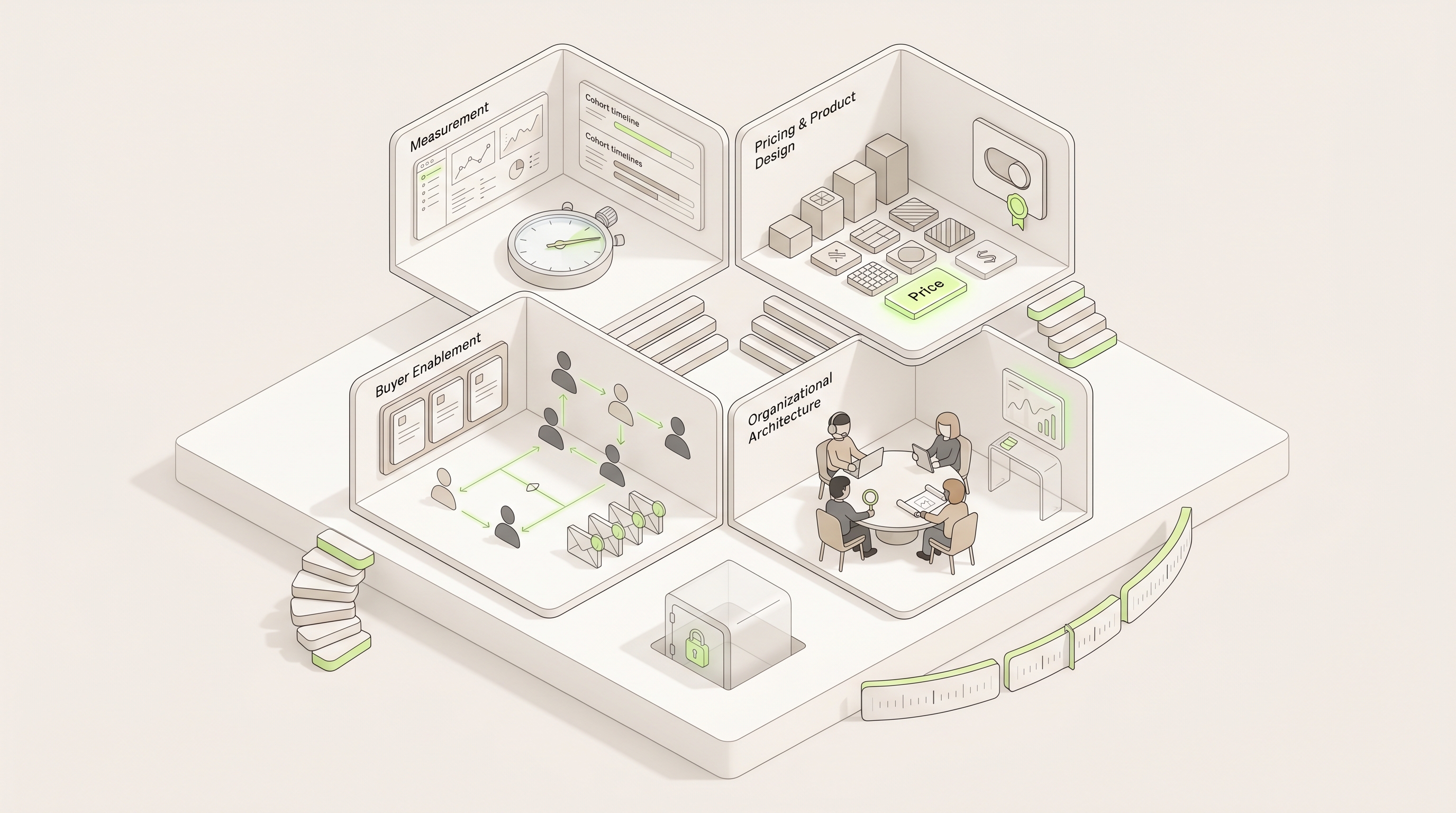
If the problem is architecture, the remedy must be architectural. Fixing velocity is not about more SDRs. It is about four systems that must be engineered together. Call them Measurement, Pricing and Product Design, Buyer Enablement, and Organizational Architecture. Each moves the dial on cycle time and each has direct revenue consequences.
1. Measurement, the constraint you can change fast
You cannot improve what you do not measure in the right way. Volume metrics lie; driver-based metrics tell the truth. Replace gut forecasts with a small set of driver KPIs that link directly to close timing and cash.
Core KPIs to own weekly
— Time in stage by cohort, not average time. Break cohorts by ACV, vertical, and buying committee size.
— Leads to qualified opportunity conversion, trended weekly.
— Opposition to win rate, by rep and by segment.
— No-decision rate, with reasons captured in a forced-choice field.
— CAC payback window and NRR by cohort.
Operate a pipeline autopsy engine. Run a weekly variance triage. If time-in-stage moves +10% in any high-value cohort, trigger a focused intervention. The autopsy is not blame. It is a surgical process that isolates which input changed, then prescribes a targeted fix. Firms that run this discipline compress cycles by 20 to 30 percent within a quarter.
2. Pricing and product design, where speed and margin meet
Pricing shortens procurement scrutiny when it removes ambiguity. Usage models helped growth as consumption exploded, but they also created complexity that lengthens buying cycles because procurement and finance need scenario analysis. The lever is deliberate price architecture.
Practical moves
— Front-load value capture in early tiers so customers realize measurable ROI before long-term billing ramps. That reduces buyer friction.
— Build and test outcome contracts for select segments. These shift some risk to you, but they also remove elongated ROI debates and accelerate deals. Model the downside conservatively and cap exposure.
— Run sensitivity tests on usage tiers to identify where small price changes reduce procurement time. Often a modest increase in up-front pricing buys weeks of time back.
When done right, pricing changes shorten procurement windows and lift ACV. When done wrong, they create churn. That is why you must A/B test with cohorts and link every pricing experiment to NRR and payback impact, not just ACV.
3. Buyer enablement, engineered for momentum
Long cycles are often processes of stalled momentum. Buyers can self-educate, but they do not always self-decide. Your job is to make decision the path of least resistance.
Strategy
Map the buying committee, not as a hypothetical, but as a documented artifact for every enterprise opportunity. When the committee averages 11 stakeholders, the job is coordination, not persuasion. Create decision kits targeted to each persona, with the single page that answers their question: risk, ROI, compliance, integration, and peer evidence.
Tactical plays
— Decision kits that combine an ROI calculator, a short technical integration note, and two peer case studies tailored to the buyer's industry and size.
— AI-personalized emails and executive summaries that surface the exact metric the stakeholder cares about. Use automation to reduce touch volume while increasing relevance.
— Momentum milestones in your process. Define the three commitments that indicate a deal will close. Make them explicit in CRM and require confirmation from a named stakeholder.
This is not automation for convenience. It is engineering buyer inevitability. The result is fewer stalls and cleaner forecasts.
4. Organizational architecture, where decisions scale
Velocity is a people problem and a coverage problem. When you add reps to hit a number, you create linear cost. The alternative is smarter coverage and embedded analytics.
Tactical structures
— Revenue pods that pair an AE, an SDR, a solutions architect, and a strategy analyst. The analyst owns weekly variance and test design. This reduces blind spots and speeds rebuttals to procurement objections.
— Time allocation rules. Reassign 20 to 30 percent of AE time to micro-expansion plays in existing accounts. Micro-expansions compound NRR and buy you time on new logo cycles.
— Ruthless disqualification. Build LTV gates into CRM. Auto-nurture low-LTV or high-no-decision risk accounts into low-touch sequences. Free capacity for high-velocity segments.
Headcount is still necessary. But hire for competitive wiring, not vanity metrics. The single best lever to shorten cycles is a rep who knows how to orchestrate a buying committee, not one who can increase lead volume.
Counterintuitive truths most operators avoid
Slow sales are a filter, not only a problem. Use them to disqualify low-value churn risks early. A stretched cycle that finally closes can still be a bad deal if the economic profile is weak. Top performers treat the slowdown as an opportunity to concentrate on the 20 percent of accounts that yield 80 percent of durable revenue.
AI does not mean faster closes by default. It gives buyers more independence. That reduces some inbound noise but increases procurement scrutiny. The correct use of AI is to create hyper-relevant decision assets and automate variance detection, not to replace the human orchestration required to lock multiple stakeholders into a timeline.
Outcome contracts are powerful, but they change your risk profile. Only use them where you have high confidence in delivery and clear measurement. Set caps, agree exit criteria, and instrument success so the contract shortens the buyer's approval path rather than exposing you to open-ended obligations.
A 90-day operational plan
You need a practical cadence. The following is a disciplined 90-day sprint to attack velocity without reckless change.
Days 1 to 30, Diagnose
— Run a pipeline autopsy across your top 200 opportunities by ACV. Segment by industry, deal size, comp structure, and buying committee size.
— Baseline the core KPIs listed above. Identify the three largest sources of time-in-stage.
— Implement LTV gates in CRM for new inbound qualification.
Days 31 to 60, Experiment
— Launch two pricing experiments with clear control groups, tied to NRR impact windows.
— Deploy decision kits for three proof-of-concept verticals, personalized with AI assets.
— Reassign 20 percent AE time to micro-expansion plays and measure incremental NRR.
Days 61 to 90, Scale or Kill
— Scale the interventions that shorten time-in-stage by at least 15 percent and show positive payback within 12 months.
— Codify successful workflows into playbooks and embed the strategy analyst role in three revenue pods.
— Report a new baseline to the executive team, with adjusted hiring and marketing plans based on the shortened cycle.
What success looks like
Winning teams compress time-in-stage by 20 to 30 percent within two quarters. CAC payback returns to a healthier window, or at least shortens materially from 24 months. NRR stabilizes and begins to creep upward as micro-expansions compound. Forecast accuracy improves because deals either close or are disqualified earlier. That restores capital optionality and the ability to hire strategically.
Final precision
If sales feel slower, act like an architect. Measure the right drivers. Reframe pricing so procurement has fewer reasons to stall. Build decision assets that create buyer inevitability. Reorganize coverage so talent multiplies throughput instead of adding linear cost.
This is not a motivational pep talk. It is construction. Slow sales are the symptom. The constraint is the architecture. Fix the architecture and speed will follow. When that happens revenue compounds, not just grows.
Frequently Asked Questions
Why are sales cycles materially longer since 2023, and how should that change my growth priorities?
Macro caution, larger buying committees, and buyers self-educating with AI have turned predictable calendars into conditional pipelines.
Treat velocity as an architecture problem, not a lead problem, and prioritize systems that reduce time-in-stage, protect cash, and shorten CAC payback rather than simply increasing top-of-funnel spend.
What are the most actionable KPIs to track weekly to compress cycles?
• Track time-in-stage by cohort
• Leads to qualified opportunity conversion
• Opposition to win rate by segment
• No-decision rate with forced reasons
• CAC payback by cohort
Use these driver metrics to trigger targeted interventions when any high-value cohort moves +10 percent in time-in-stage.
How do I run a pipeline autopsy without creating finger-pointing across reps?
Frame the autopsy as a surgical variance triage that isolates which input changed, then prescribes a targeted fix; make it data-driven and brief.
Require cohorts, forced-choice reasons for stalls, and an action owner for fixes, so the process becomes engineering not blame and compresses cycles 20 to 30 percent within a quarter.
When should I experiment with pricing versus when should I change product design to speed procurement?
Start with price architecture when procurement stalls on ambiguity, test small increases in up-front capture and usage tier sensitivity.
Use product design when technical integration or ROI proof is the blocker, but always A/B test with cohorts and tie experiments to NRR and payback, not just ACV, to avoid creating churn.
What are practical steps to build buyer enablement that actually moves deals faster?
• Map the buying committee for each enterprise opportunity
• Create one-page decision kits per persona that answer risk, ROI, compliance, integration, and peer evidence
• Automate AI-personalized executive summaries
• Define three explicit momentum milestones in CRM and require named stakeholder confirmations to make decision the path of least resistance
How should I structure revenue teams to increase velocity without linear headcount growth?
Move to revenue pods pairing an AE, SDR, solutions architect, and a strategy analyst who owns weekly variance and test design.
Reassign 20 to 30 percent of AE time to micro-expansion plays, enforce LTV disqualification gates, and hire for committee orchestration skills to multiply throughput rather than add cost linearly.
What trade-offs come with offering outcome contracts to accelerate deals?
Outcome contracts shorten ROI debates and can accelerate procurement, but they shift risk to you and require conservative downside modeling, caps, and clear exit criteria.
Only use them where delivery confidence is high and instrument success to ensure they shorten approval paths without exposing you to open-ended obligations.
How do I decide which deals to disqualify when cycles are stretched?
Use the slowdown as a filter by applying LTV gates, no-decision risk scoring, and time-in-stage thresholds; if a high time-in-stage deal shows weak economic profile or repeated no-decision reasons, move it to auto-nurture.
Disqualification frees capacity for high-velocity, high-LTV opportunities and protects NRR and CAC payback.
What specific metrics will show my 90-day plan is working?
• 15 to 30 percent reductions in time-in-stage for targeted cohorts
• Compressed CAC payback toward a healthier window
• Improving NRR trends driven by micro-expansions
• Forecast accuracy gain and the percent of deals that either close or are disqualified earlier
How should I use AI to speed closes without increasing procurement scrutiny?
Use AI to personalize decision assets, automate variance detection, and surface stakeholder-specific ROI, not to replace human orchestration.
The correct use reduces touch volume while increasing relevance, which helps lock stakeholders into timelines instead of giving them more fuel to delay decisions.
What are low-risk pricing experiments that typically buy time back from procurement?
• Run sensitivity tests on usage tiers for small price adjustments
• Front-load value capture in early tiers
• Test capped outcome-style offers for narrow segments
Always run controlled cohorts, measure impact on NRR and payback, and scale only when you see positive payback within your planning horizon.
When is it better to hire headcount versus redesigning coverage to improve velocity?
Hire when capacity constraints are systemic and forecasted demand needs persistent coverage; otherwise redesign coverage first by forming revenue pods, reallocating AE time to expansions, and adding a strategy analyst.
Redesign preserves margin and proves the velocity lift before committing to linear headcount growth.
How do micro-expansions help when new logo cycles are lengthy?
Micro-expansions increase NRR and cash flow, buying time while new logo cycles close, often with lower procurement friction.
Reassigning 20 to 30 percent of AE time to these plays compounds revenue without proportional hiring and shortens overall CAC payback.
What governance is needed to scale successful velocity interventions after the 90-day sprint?
• Codify winning workflows into playbooks
• Embed the strategy analyst role in pods
• Require weekly driver KPI reviews with executive reporting on new baselines
• Tie hiring and marketing plans to the new cycle metrics
Scale only interventions that show at least 15 percent time-in-stage improvement and positive 12-month payback.
Key Takeaways
• Treat elongated sales cycles as an operating architecture problem, not a lead problem, because fixing the architecture compresses cycle time, protects cash, and scales ARR without linear headcount growth.
• Replace volume metrics with driver-based weekly KPIs such as time-in-stage by cohort, leads-to-qualified conversion, opposition-to-win rate, and no-decision rate, because surgical measurement isolates the input to act on and can cut cycle time 20 to 30 percent within a quarter.
• Reengineer pricing and product design to front-load value and trial outcome contracts, because deliberate price architecture reduces procurement friction, shortens CAC payback windows, and increases ACV while preserving NRR when A/B tested.
• Build buyer inevitability by mapping and documenting buying committees, delivering persona-specific decision kits, and enforcing momentum milestones in CRM, because coordination across stakeholders improves forecast accuracy and accelerates close timing.
• Shift organizational architecture from adding heads to smarter coverage, deploying revenue pods with an embedded strategy analyst, reallocating AE time to micro-expansion, and enforcing LTV gates, because competitive-wired reps and embedded analytics multiply throughput without proportional cost.
• Treat slow deals as a filter and run a disciplined 90-day cadence of pipeline autopsies, targeted experiments, and scale-or-kill decisions, because only interventions that shorten time-in-stage and prove positive 12-month payback preserve capital optionality and durable revenue.


