

Motivation fades. But systems? Systems scale.
If your team is hustling but not closing, it’s not an effort problem; it’s an enablement problem. Most sales teams aren’t failing because they lack talent; they’re failing because they lack structure, process, and alignment.
That’s where sales enablement training comes in. It’s the backbone of modern sales success, the bridge between potential and performance.
Enablement isn’t just another buzzword. It’s the strategic synchronization of content, process, and people to help your sales reps perform at their absolute peak.
At The Vault Unlocked, we’ve seen what happens when enablement clicks into place, sales cycles shorten, conversions climb, and teams operate like a well-oiled machine.
By the end of this article, you’ll know the top programs, frameworks, and strategies driving elite sales results worldwide, and how to choose one that fits your business.
What Is Sales Enablement Training?
The Evolution of Sales Enablement
Traditional sales training told reps what to do. Sales enablement empowers them to do it better.
We’ve evolved from one-off seminars to continuous performance ecosystems. What was once manual is now data-driven, automated, and increasingly powered by AI.
In this modern era, enablement isn’t just training; it’s the ongoing integration of tools, data, and coaching that turns good salespeople into top performers.
The Key Pillars of Sales Enablement
Sales enablement stands on four unshakable pillars:
- Training: Building skills through real-world practice and behavioral improvement.
- Content: Equipping reps with the right materials at every stage of the buyer journey.
- Technology: Using CRMs, automation, and learning systems to streamline.
- Coaching: Reinforcing learning through feedback and role-play.
It’s simple: training gives knowledge, enablement creates mastery.
How It Differs from Traditional Sales Training
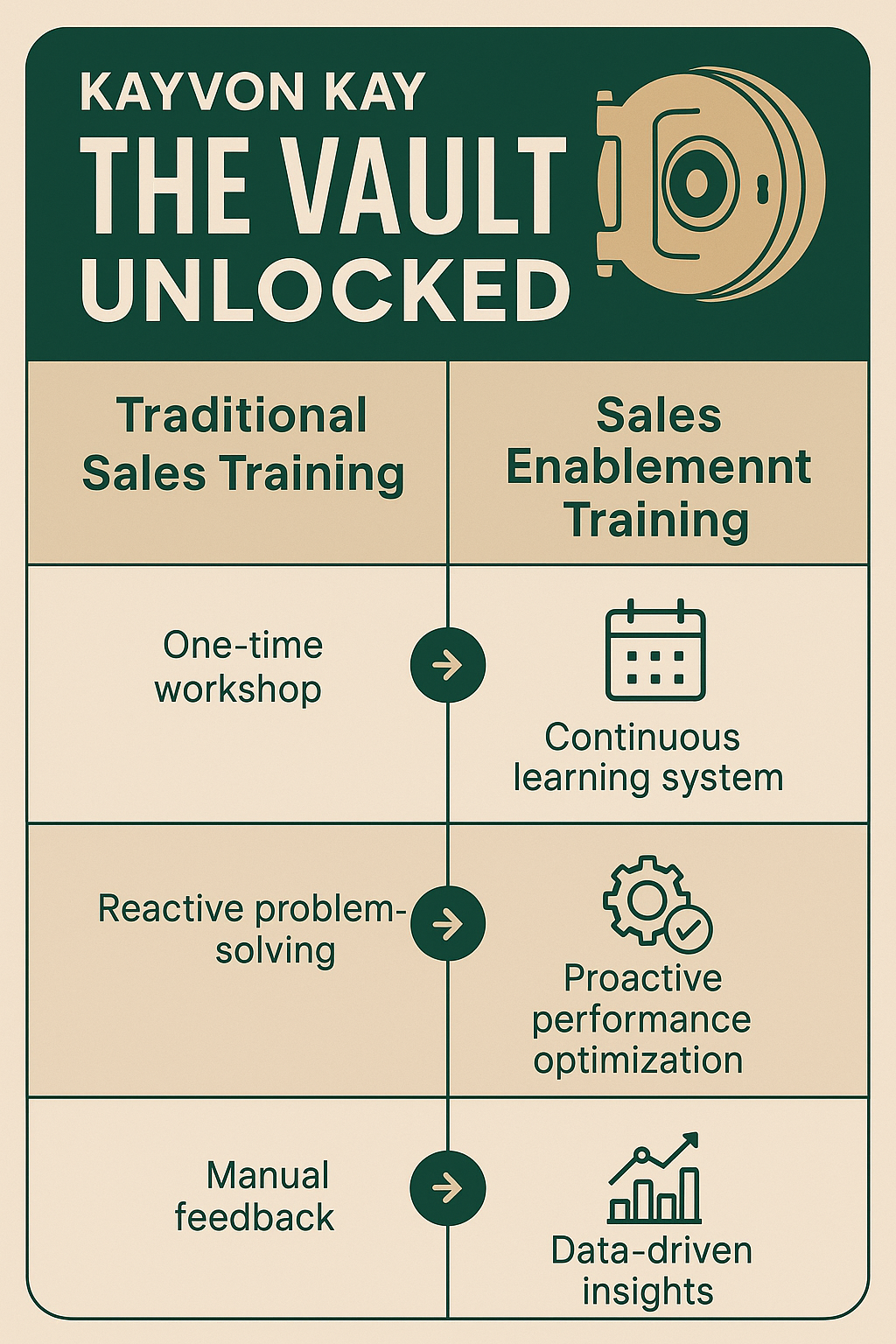
Enablement isn’t an event; it’s an ecosystem.
Why It Matters in 2025
Today’s buyer is more informed, more digital, and less patient. Remote selling, AI-powered outreach, and content-heavy journeys demand more innovative enablement systems.
That’s why high-performing teams are adopting frameworks from HubSpot, Mindtickle, and Kayvon Kay’s own Enablement System, all of which are built for adaptive, digital-first sales environments.
Benefits of Implementing Sales Enablement Training
Boosts Team Productivity and Efficiency
Sales enablement training doesn’t just make reps better, it makes them faster. By automating repetitive tasks and streamlining processes, teams ramp up faster and close deals sooner.
Improves Sales and Marketing Alignment
When sales and marketing operate as one, everything falls into place. Shared goals, unified messaging, and smoother handoffs eliminate confusion and wasted effort. The result? A stronger, more consistent buyer experience and a revenue engine that moves in perfect sync.
Enhances Buyer Experience
Reps learn to deliver the right message at the right time, guiding buyers with clarity and confidence. Enablement aligns communication to the buyer journey, not just the quota.
Data-Driven Performance Insights
Analytics and AI provide visibility into what works and what doesn't. From CRM dashboards to behavior tracking, enablement empowers leaders to refine performance in real-time.
Improves Retention and Motivation
Enablement turns growth into a habit. Reps who feel supported by training, coaching, and recognition don’t just perform better, they stay longer.
Core Components of an Effective Sales Enablement Program
Personalized Learning Paths
Forget one-size-fits-all. Modern enablement programs use AI to personalize learning based on rep performance and skill gaps.
Continuous Learning Culture
Short, consistent training beats long, sporadic workshops. Microlearning, peer-to-peer sessions, and daily skill reinforcements keep teams sharp and focused. Mindtickle’s reinforcement model delivers continuous, bite-sized training through 5-minute microlearning modules designed to strengthen retention over time.
Role-Based Enablement Modules
Different roles, different needs. SDRs focus on outreach, AEs on closing, and Customer Success on retention. Enablement tailors training for every function.
Role-Playing and Scenario-Based Learning
Nothing replaces practice. Role-plays simulate objections, demos, and negotiations, transforming theory into instinct.
Integration with CRM and Sales Tools
Enablement thrives when training is tied to performance data. CRMs like HubSpot and Salesforce, as well as tools like Gong and Outreach, make that connection seamless.
Data and Analytics Dashboards
Measure what matters. Completion rates, performance lift, and coaching effectiveness keep enablement programs accountable.
Manager Enablement
Sales leaders need training, too. Leadership modules and communication frameworks ensure managers can coach, not just command.
10 Best Sales Enablement Training Programs That Drive Success
When it comes to sales enablement, not every program is created equal. Some are great for building foundations, while others are engineered for scaling enterprise-level teams. Below are ten programs that stand out, each with a unique approach to helping your team sell smarter, faster, and with more consistency.
1. HubSpot Academy – Sales Enablement Certification
If your team runs on inbound marketing, HubSpot Academy is a must. Their Sales Enablement Certification program is free, structured, and directly integrated into the HubSpot CRM ecosystem.
You’ll learn how to:
- Align sales and marketing for smoother lead handoffs.
- Build content strategies that convert.
- Develop data-backed workflows to shorten sales cycles.
It’s perfect for SMBs and teams that want an accessible, self-paced path to mastering modern enablement fundamentals.
2. Mindtickle – Sales Readiness Training
Mindtickle is where AI meets enablement excellence. Designed for enterprise scalability, it utilizes advanced analytics, gamified learning, and virtual role-playing to measure and improve representative performance.
Why teams love it:
- Real-time coaching through AI-driven feedback.
- Personalized learning paths based on performance data.
- Gamified leaderboards that keep reps engaged and competitive.
It’s ideal for global organizations that want a measurable, high-energy approach to enablement at scale.
3. LinkedIn Learning – Sales Enablement Foundations
For teams new to sales enablement, LinkedIn Learning’s Sales Enablement Foundations provides a solid foundation.
This program focuses on:
- Understanding the buyer journey.
- Aligning team communication across departments.
- Using LinkedIn tools to nurture and convert leads.
It’s self-paced, affordable, and ideal for startups or small teams seeking to establish strong sales habits from the outset.
4. Salesforce – Sales Enablement Platform
If you’re already using Salesforce, this one’s a no-brainer. Their integrated Sales Enablement Platform ties training, analytics, and CRM workflows together in one place.
What it does best:
- Embeds enablement content right into daily workflows.
- Tracks performance directly through your CRM.
- Provides AI-powered insights into rep behavior and deal progression.
The result? A perfect feedback loop where learning meets execution, in real-time.
5. Highspot – Sales Enablement Software
Highspot takes a holistic approach, combining content, coaching, and analytics into a single, powerful system.
It helps teams:
- Deliver consistent messaging through content management.
- Reinforce learning with in-platform coaching tools.
- Analyze what content drives the highest close rates.
Highspot is best suited for hybrid sales teams that need unified access to content and coaching tools from anywhere.
6. Brainshark – Video-Based Coaching Platform
Brainshark is the go-to solution for teams that value effective communication. Its video-based coaching and scorecard system helps sales professionals perfect their messaging and presentation delivery.
Here’s how it stands out:
- Reps record and submit practice pitches.
- Managers review, score, and provide feedback.
- Consistent message delivery across the organization.
Ideal for organizations focused on improving storytelling, demos, and presentation confidence.
7. Seismic – Enterprise Sales Enablement Solution
Seismic is an enterprise-grade powerhouse that integrates enablement, content, and analytics into one seamless platform.
Core strengths:
- Advanced insights dashboards for leadership teams.
- Centralized sales and marketing content repository.
- Deep integrations with CRMs like Salesforce and HubSpot.
Seismic is built for large, data-driven organizations looking to unify their go-to-market operations and scale enablement globally.
8. Showpad – Visual Sales Enablement Platform
Showpad combines powerful content management with real-time engagement analytics. It’s all about creating visual buyer experiences that convert.
Top features include:
- Interactive content libraries for reps.
- Real-time buyer engagement tracking.
- Integration with major CRM and marketing systems.
Showpad is a fit for teams that thrive on storytelling, demos, and visually rich presentations, especially in SaaS and tech-driven industries.
9. Allego – Social Learning and Collaboration Hub
Allego’s strength lies in peer-to-peer learning. It’s a modern, social platform that turns your sales team into a collaborative learning community.
What makes it unique:
- Short-form video sharing for on-demand learning.
- Peer feedback loops for fast skill refinement.
- Real-time coaching moments and best-practice libraries.
Perfect for organizations that value culture-driven growth and team-wide knowledge sharing.
10. Kayvon Kay’s Sales Enablement Framework
Finally, Kayvon Kay’s proprietary Sales Enablement Framework is the only human-first system designed to bridge the gap between psychology and process.
This framework integrates performance psychology, behavioral design, and tactical training into a cohesive model for enablement.
Here’s how it works:
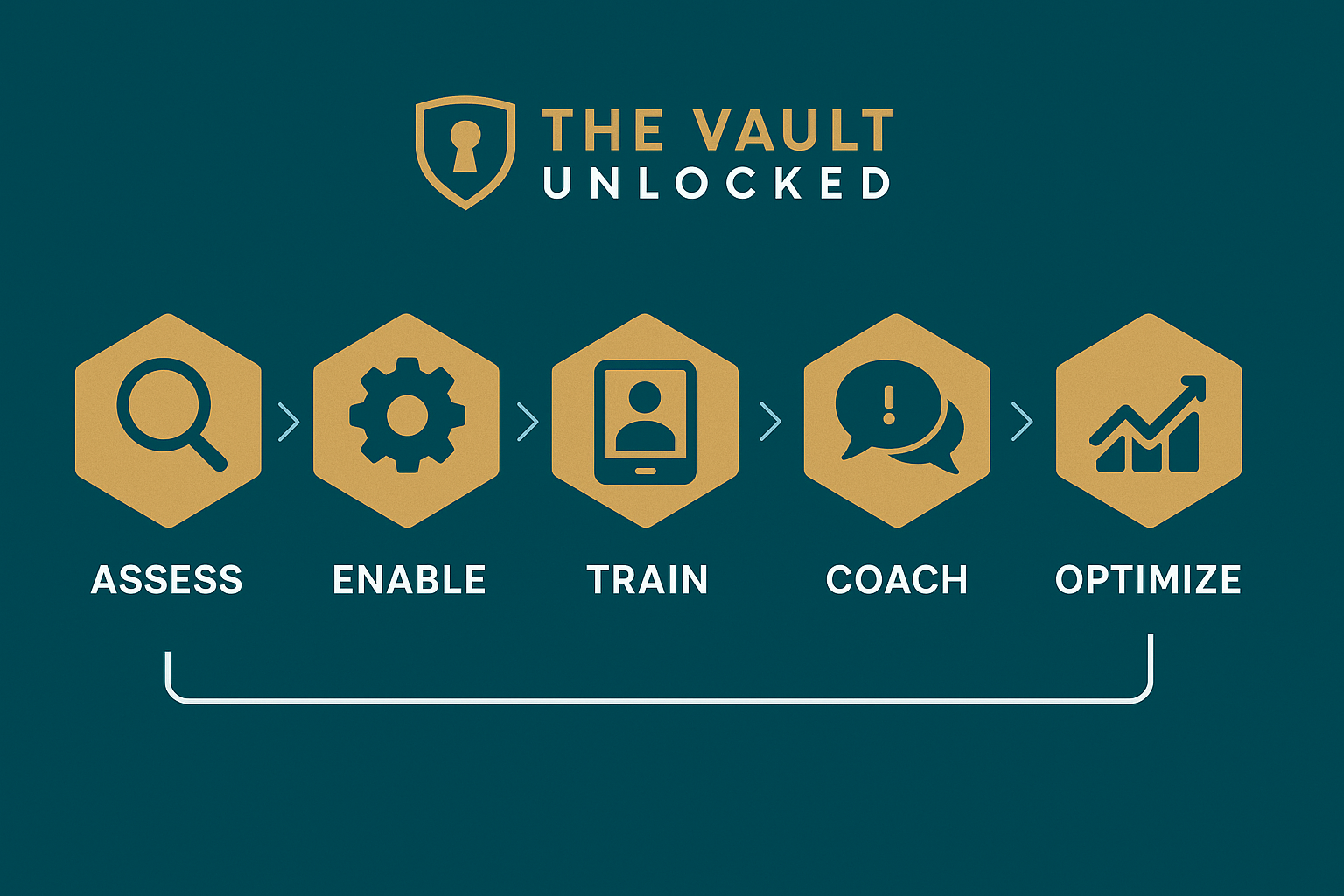
Each phase builds on the last to transform your team from reactive to relentless. It’s best for small to mid-sized sales teams ready to scale, align, and outperform competitors — without losing the human element.
At The Vault Unlocked, we’ve utilized this model to help teams shorten sales cycles, boost confidence, and drive exponential growth by focusing on the mindsets and mechanics that move the needle.
How to Build and Execute a Winning Enablement Strategy
- Conduct a Sales Skills Gap Analysis: Review CRM data, performance reports, and feedback.
- Align Training Goals with Business Objectives: Tie enablement to measurable KPIs like quota attainment and ramp-up time.
- Choose the Right Tools: Prioritize scalability, integration, and analytics.
- Create Engaging Multi-Format Content: Use micro-courses, video training, and live workshops.
- Implement Gamification: Add recognition, leaderboards, and progress tracking.
- Iterate Based on Data: Continuously improve based on performance analytics.
Measuring the Impact of Sales Enablement Training
Key Metrics to Track
- Time-to-productivity
- Quota attainment rate
- Deal win percentage
- Sales cycle length
Using Analytics to Refine Strategy
Leverage CRM and AI tools to track enablement outcomes and predict future performance.
Connecting Training to Revenue
Enablement drives confidence, and confidence closes deals, leading directly to measurable revenue growth.
The Future of Sales Enablement Training
AI is changing the game, not replacing humans, but enhancing them.
- AI-Powered Coaching: Personalized micro-lessons based on performance data.
- Real-Time Enablement Tools: Instant feedback and in-call coaching.
- Gamified Learning: AR/VR simulations for immersive practice.
- Human + AI Hybrid: “AI can automate data, but only humans build trust.” — Kayvon Kay
Common Challenges (and How to Overcome Them)
Even the best sales enablement strategy can fall flat if it’s not executed with intention. Here are the most common challenges teams face, along with expert advice on how to overcome them.
1. Low Adoption
You can have the best tools and training in the world, but if your team isn’t using them, none of it matters.
The fix? Get leadership involved. When leaders model engagement and reinforce the importance of enablement, adoption follows. Add a layer of gamification, such as leaderboards, recognition, and small wins, to make participation fun, not forced. Motivation fades, but momentum sticks when reps feel seen and celebrated.
2. Misalignment Between Sales and Marketing
Sales blames marketing for bad leads. Marketing blames sales for not following up. Sound familiar?
The solution is shared accountability. Create unified KPIs, hold joint planning sessions, and develop a single content and communication strategy that serves both teams. When everyone’s rowing in the same direction, friction disappears and conversions climb.
3. Tech Overload
Too many tools can kill productivity. When your tech stack is bloated, reps spend more time toggling between platforms than selling.
Simplify by auditing your tools and integrating systems like HubSpot, Salesforce, or Gong to centralize everything, CRM, enablement, and analytics. Automation should make your life easier, not more complicated.
4. Poor Measurement of Training Effectiveness
If you’re not measuring impact, you’re guessing. Most teams fail here because they focus on tracking activity rather than outcomes.
The fix is simple: use real-time dashboards to monitor progress and hold quarterly reviews to connect enablement metrics with revenue results. Look at ramp-up time, win rates, and rep engagement. What gets measured improves, what doesn’t gets ignored.
FAQs About Sales Enablement Training
Q: How long does sales enablement training take to show results?
A: Most teams see measurable performance improvements within 60–90 days.
Q: What’s the difference between sales training and enablement?
A: Training builds skills; enablement sustains performance.
Q: How much does a program cost?
A: Costs range from $1,000 to $15,000, depending on size and customization.
Q: Who should lead sales enablement?
A: Sales or revenue operations leaders working with enablement specialists.
Q: Is certification necessary?
A: It’s not mandatory but highly beneficial for structured development.
Conclusion
Sales enablement isn’t just training, it’s transformation. It’s what separates top-performing teams from those chasing motivation.
Empowered teams close more deals, stay aligned, and scale faster.
Start your enablement journey today with one of these top programs, or build your own framework with Kayvon Kay and Vault Unlocked.
🎧 Tune into The Vault Unlocked Podcast for real conversations with elite sales leaders mastering enablement and growth.


