

Poor communication isn’t just a minor problem; it’s a silent business killer. According to Grammarly Business and The Harris Poll, U.S. companies lose up to $1.2 trillion annually due to miscommunication, which is roughly $12,506 per employee every year.
The message is clear: when communication breaks down, so does performance. But the good news? Communication is a skill. And like any skill, it can be developed, refined, and mastered.
At The Vault Unlocked, Kayvon Kay teaches leaders and teams how to turn communication into a competitive advantage, creating conversations that drive clarity, alignment, and results.
This guide breaks down 9 proven ways to improve communication skills in the workplace, so you can build teams that collaborate better, lead with trust, and execute with precision.
🎧 Want deeper insights into leadership and communication? Tune into The Vault Unlocked Podcast, where Kayvon breaks down real-world frameworks that drive human performance and business growth.
1. Master Active Listening
Most people don’t listen to understand; they listen to reply. Active listening flips that script. It’s about being fully present in a conversation, understanding both what’s said and what’s unsaid.
How to practice it:
- Maintain eye contact and avoid interruptions.
- Reflect what you hear (“What I’m hearing is…”).
- Ask clarifying questions instead of jumping to solutions.
Active listening builds trust faster than any motivational speech ever could. When people feel heard, they engage deeper, contribute more, and communicate better.
2. Communicate with Clarity: No Corporate Jargon
Clarity is power.
In fast-paced organizations, messages get diluted through layers of jargon and complexity. The result? Misalignment, confusion, and frustration.
The rule: If your team can’t repeat your message clearly after hearing it once, it’s too complicated.
To communicate with clarity:
- Use simple, direct language.
- Replace abstract buzzwords with real examples.
- End every conversation with action-based takeaways (“Who’s doing what by when?”).
As Kayvon says on The Vault Unlocked, “Clarity creates momentum. Confusion kills it.”
3. Build Emotional Intelligence (EQ)
Emotionally intelligent leaders don’t just manage people, they move them.
According to Forbes, 90% of top performers score high in emotional intelligence, and teams led by emotionally intelligent leaders experience higher engagement and retention.
How to strengthen EQ in communication:
- Recognize your own emotional triggers.
- Read the tone, pace, and energy of others.
- Respond, don’t react, especially in tense moments.
High-EQ leaders know when to challenge, when to listen, and when to coach. That balance builds lasting trust.
4. Tailor Your Message to the Audience
Great communicators don’t speak at people, they speak to them. Your engineers, sales reps, and executives all interpret information differently. A one-size-fits-all communication style creates friction.
Tailoring your message means:
- Adjusting tone and format for each audience.
- Using data with analysts, vision with leaders, and stories with clients.
- Matching delivery to context, email, meeting, Slack, or face-to-face.
When you communicate in a way that meets people where they are, your message sticks.
5. Create Feedback Loops That Work
Feedback isn’t criticism, it’s collaboration. The most effective teams normalize feedback as a growth tool, not a threat.
According to Gallup, employees who receive regular, meaningful feedback are 3.6 times more engaged than those who don’t.
To build a feedback-driven culture:
- Schedule consistent 1:1s, not just annual reviews.
- Encourage upward feedback from team members.
- Deliver feedback using the “SBI” model: Situation, Behavior, Impact.
Leaders who give and invite feedback create psychological safety, which drives innovation and accountability.
6. Leverage Technology for Better Communication
In a hybrid world, communication doesn’t just happen in meetings; it happens across platforms.
Tools like Slack, Microsoft Teams, Notion, and Loom can streamline conversations, document updates, and create transparency. But tools alone don’t solve poor communication; systems do.
Here’s how to optimize tech communication:
- Define what goes where (urgent = chat, updates = email, strategy = meeting).
- Use async tools for flexibility and focus.
- Document everything; clarity loves documentation.
Digital communication is only as effective as the culture guiding it.
7. Communicate Vision, Not Just Tasks
Leaders often assume people understand why their work matters. Most don’t. When communication focuses only on tasks and metrics, teams lose sight of the bigger mission. As a result, motivation dips, and so does performance.
How to fix it:
- Tie every initiative back to purpose and impact.
- Start meetings with “why” before the “how.”
- Celebrate wins that reinforce shared goals.
In Kayvon’s words, “Vision is the language of leadership. The more clearly you communicate it, the more people will follow it.”
8. Develop Nonverbal Communication Skills
Up to 93% of communication is nonverbal, according to Psychology Today. Body language, tone, and facial expressions often speak louder than words.
How to master nonverbal communication:
- Maintain open posture and steady eye contact.
- Match tone and energy to the message.
- Notice cues from others, crossed arms, pauses, micro-expressions.
Nonverbal communication is your secret leadership signal. It reveals confidence, empathy, and intent before you even speak.
9. Practice Radical Transparency
Transparency is trust in action. Teams thrive when communication is honest, consistent, and inclusive.
According to Harvard Business Review, transparent companies see higher engagement, innovation, and retention.
What transparency looks like in practice:
- Sharing context, not just conclusions.
- Admitting when you don’t know something.
- Giving people visibility into goals and progress.
Transparency doesn’t weaken leadership; it strengthens it. When people understand the “why,” they commit to the “how.”
Encourage Cross-Functional Communication
Silos are the enemy of innovation. Encouraging collaboration between departments, marketing with sales, product with support, fuels creativity and alignment.
To break silos:
- Create shared projects and outcomes.
- Use team standups or “alignment huddles.”
- Recognize collaborative success publicly.
A connected company is a powerful company.
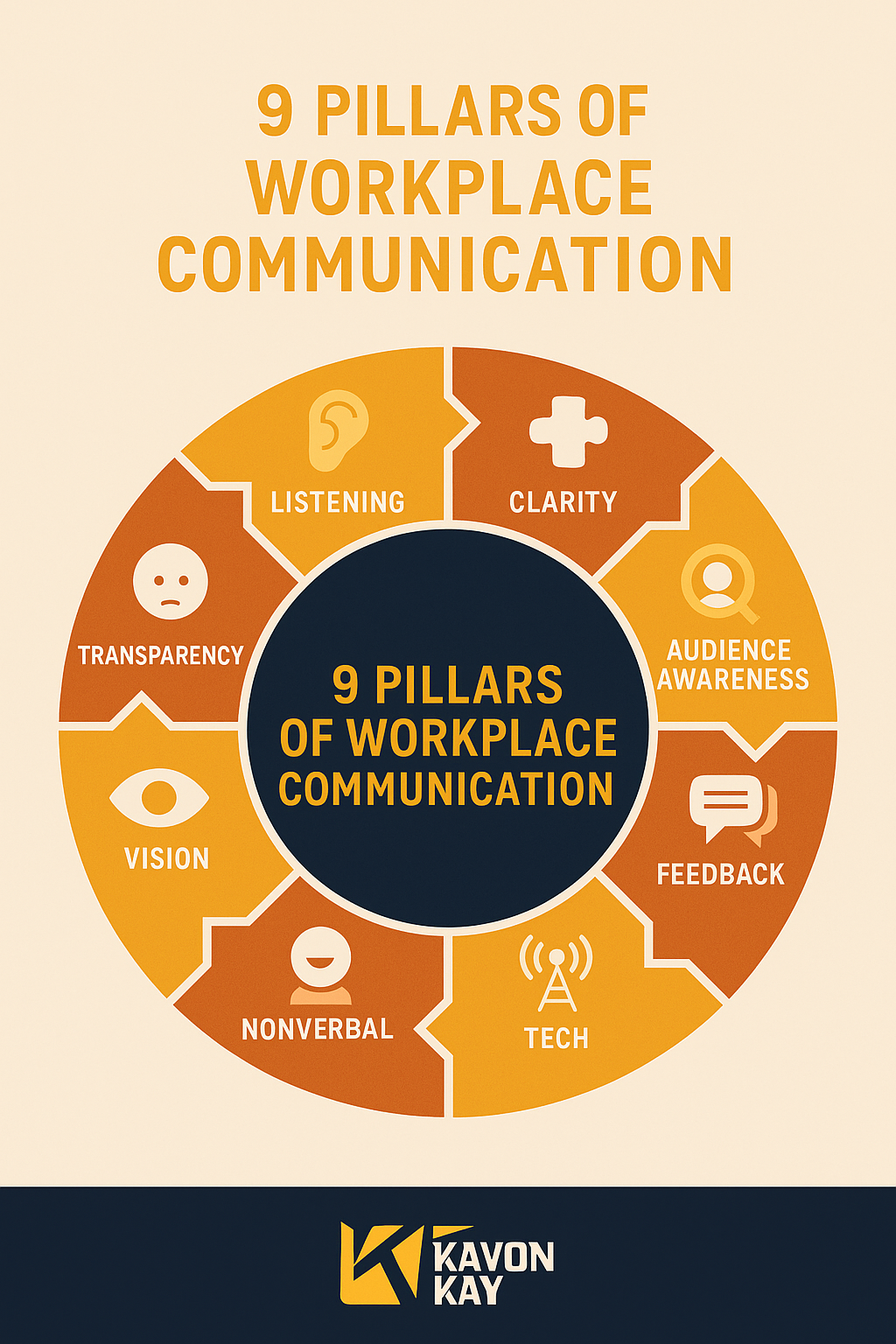
Elite Teams Are Built on Strong Communication
Great teams don’t rise because of talent alone; they rise because they know how to communicate. When communication is intentional, clear, and emotionally intelligent, everything changes: performance improves, trust deepens, and leadership thrives.
Explore Kayvon Kay’s corporate training frameworks or tune into The Vault Unlocked Podcast for powerful conversations on leadership, communication, and human performance.
FAQs: Communication Skills in the Workplace
1. Why are communication skills important at work?
Strong communication builds trust, collaboration, and efficiency, key drivers of performance and morale.
2. How can leaders improve workplace communication?
By modeling transparency, listening actively, and aligning communication with company values.
3. What are the most common workplace communication barriers?
Lack of clarity, poor feedback culture, information silos, and overreliance on email or chat.
4. What’s the role of emotional intelligence in communication?
EQ helps leaders manage tone, timing, and empathy, turning tension into trust.
5. How do remote teams improve communication?
By combining structured check-ins, clear documentation, and video calls that build a human connection.


